Guide
Best Red Chilli Powder in India: Guntur vs Byadgi vs Kashmiri
6 min read
Guntur vs Byadgi vs Kashmiri red chilli powder — heat (SHU) vs colour (ASTA), how to choose by dish, and why a COA protects you from added colour.
There is no single "best" red chilli powder — there is the right one for the dish in front of you. Indian cooking quietly asks two different things of lal mirch: sometimes you want heat that builds at the back of the throat, and sometimes you want a deep, glowing red colour without setting anyone's mouth on fire. Most people buy one generic chilli powder and try to make it do both jobs. Understanding three classic varieties — Guntur, Byadgi and Kashmiri — and the trade-off between heat and colour will change how you season for good.
The core trade-off: heat vs colour
Two simple ideas explain almost everything about chilli powder. Heat is measured on the Scoville scale (SHU) — how much capsaicin, the compound that makes chilli "hot", is present. Colour is measured by ASTA value — how much natural red pigment the chilli carries. The catch is that the hottest chillies are not always the reddest, and the reddest are often quite mild.
So the question is never just "how spicy is it" but "how much heat and how much colour do I want from this spoon?" Once you think in those two dimensions, choosing the right variety becomes easy.
Guntur — heat with a bright red
Guntur chilli, grown around Guntur in Andhra Pradesh, is the workhorse of fiery Indian cooking. It brings genuine, assertive heat — a high SHU running into the tens of thousands and beyond — together with a clean, bright red colour. This is the chilli behind much of South Indian and Andhra spice, and it is what you want when a dish is supposed to be hot.
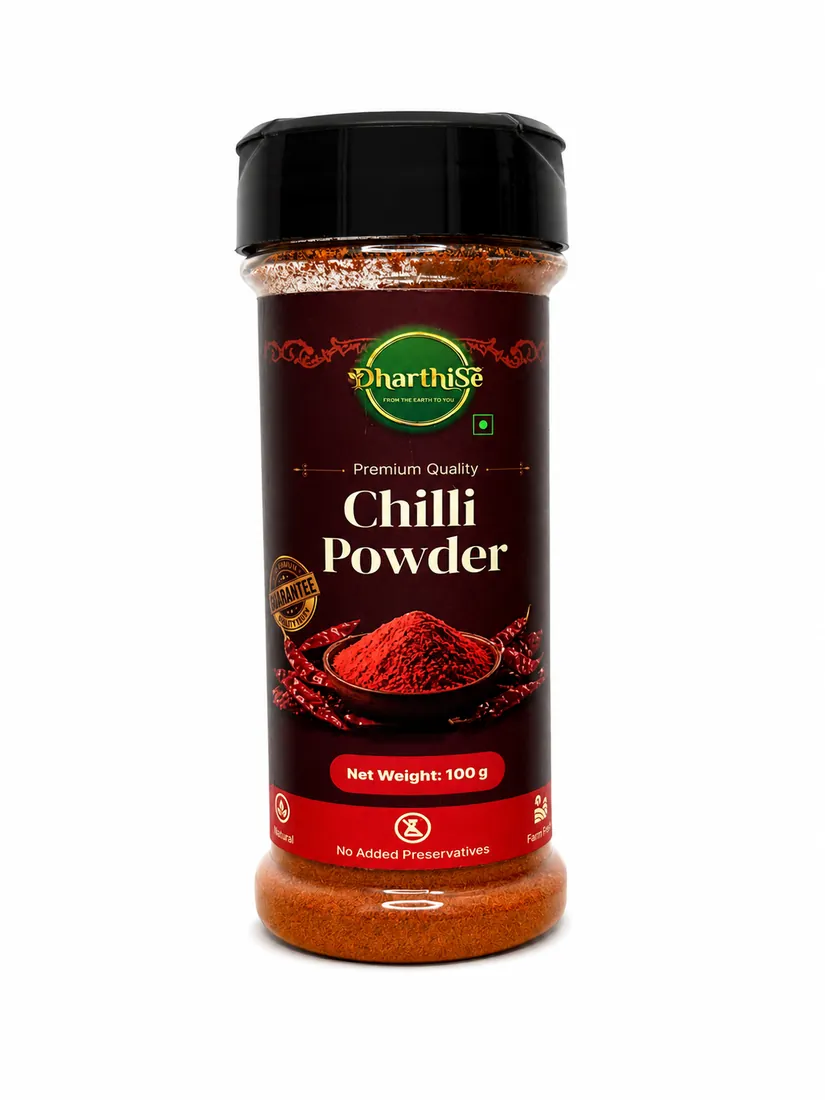
Use Guntur when heat is the point: Andhra-style curries, fiery pickles, tadkas that need to bite, and any masala where you want warmth you can actually feel. DharthiSe Red Chilli Powder is made from Guntur chillies precisely for that bright-red, high-heat character.
Byadgi — deep red colour, gentle heat
Byadgi chilli, from the Byadgi region of Karnataka, is almost the mirror image. It is prized for a deep, dark, slightly wrinkled red and a high ASTA colour value, with much milder heat — roughly in the 8,000–15,000 SHU range, far gentler than Guntur. It is the chilli that gives many restaurant gravies their rich, glossy red without overwhelming spice.
Reach for Byadgi-style colour when you want a dish to look deeply red and feel rounded rather than searing: Mangalorean and Udupi cooking, sambar powders, and gravies where colour does the talking.
Kashmiri — colour first, heat barely there
Kashmiri red chilli is the colour specialist. It delivers a rich, warm red with very mild heat, which is exactly why it is the classic choice for dishes that must look vivid but stay approachable — tandoori marinades, butter-based gravies, biryani and anything served to a mixed table where not everyone wants spice. If your goal is a beautiful red tandoori glow without burning, this is the profile you are after.
How to choose by dish
- Want it genuinely hot (Andhra curry, fiery pickle, spicy tadka): Guntur.
- Want a deep restaurant-red gravy with rounded, mild heat: Byadgi-style colour.
- Want vivid red with little heat (tandoori, butter gravies, biryani): Kashmiri.
- Everyday all-rounder: a clean Guntur powder, used by the spoonful so you control the heat yourself.
- A practical trick: many cooks blend a high-colour chilli for looks with a smaller hit of a hotter one for warmth — colour from one, heat from another.
The real warning: natural red vs added colour
Because deep red colour sells, chilli powder is one of the most adulterated spices on the shelf. The two things to be wary of are artificial dyes used to fake colour — including non-food Sudan dyes, which are not permitted in food — and cheap fillers like brick powder or starch used to bulk up the weight. A suspiciously uniform, almost lipstick-bright red can be a warning sign rather than a quality sign.
You cannot reliably judge this by eye, and home tests are only indicative. The dependable safeguard is a Certificate of Analysis (COA) for the batch — lab confirmation that the colour is the chilli's own and that no banned dyes or fillers are present. That is exactly why we test per batch rather than ask you to trust the shade in the jar.
How DharthiSe red chilli is made
DharthiSe Red Chilli Powder is 100% natural Guntur chilli — bright red, genuinely hot — with no added colour, no fillers and no preservatives, and a COA per batch. Whether you want the fiery side of Guntur or are blending it for a tandoori marinade, the colour you see is the chilli's own, traceable from the earth to you.